
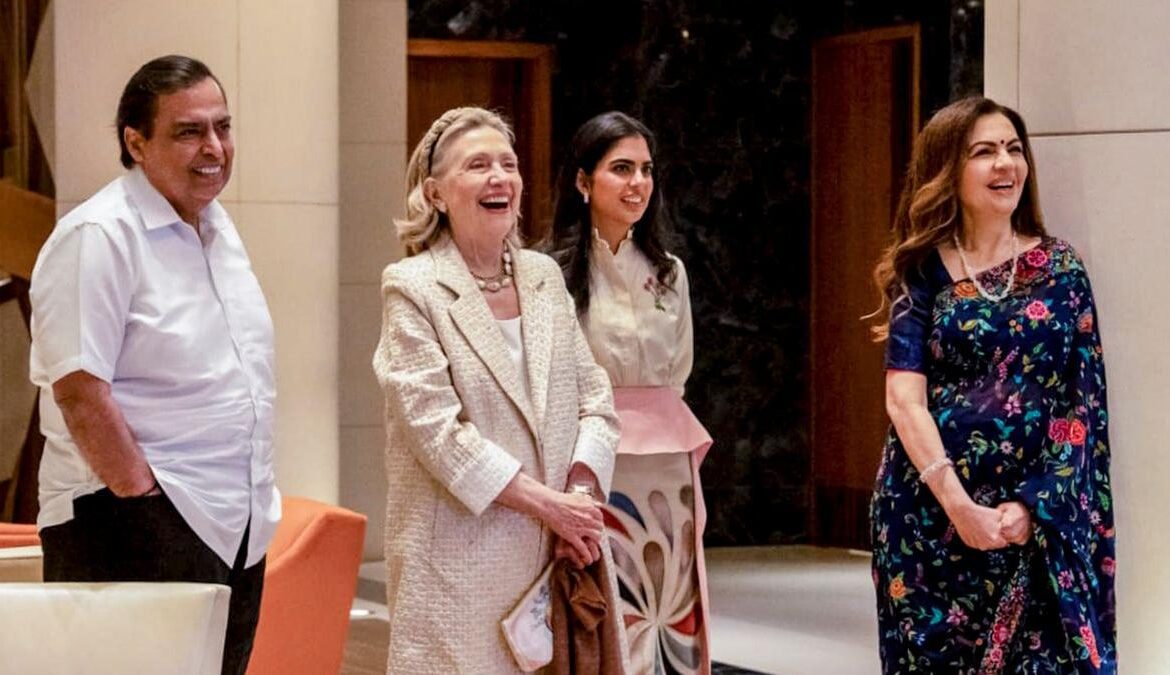
Antilia Hosts Hillary Clinton After Mumbai Climate Week 2026
Source : Twitter
A High-Profile Evening in Mumbai
In a moment that quickly captured global attention, Hillary Clinton attended a private dinner hosted by the Ambani family at Antilia, their iconic Mumbai residence, following her participation in the inaugural Mumbai Climate Week 2026.
The gathering brought together diplomacy, culture, and industry under one roof. According to posts and reactions circulating on Twitter, now known as X, the evening was described as a celebration of friendship, sustainability dialogue, and Indian craftsmanship. While many praised the cultural showcase and hospitality, some online voices raised unverified questions about political connections and past associations—highlighting how high-profile events often spark both admiration and scrutiny in equal measure.
The dinner followed Clinton’s keynote engagement at Mumbai Climate Week, where she commended India’s climate-forward initiatives and emphasized the importance of public-private collaboration in addressing global environmental challenges.
Clinton’s Visit to Mumbai Climate Week 2026
Before the private dinner at Antilia, Clinton attended the inaugural Mumbai Climate Week 2026, a platform focused on climate innovation, policy dialogue, and sustainable development.
During her remarks, she praised India’s grassroots climate solutions, specifically highlighting innovative heat insurance initiatives that have reportedly supported 500,000 women facing extreme temperature conditions. She described such programs as examples of localized innovation with global relevance.
Clinton emphasized the urgent need for stronger partnerships between governments, corporations, and civil society. She reiterated that climate resilience requires coordinated public-private action rather than isolated policy measures.
Her speech resonated strongly with climate entrepreneurs and policy advocates present at the event. On Twitter, attendees shared clips of her remarks, particularly her acknowledgment of India’s expanding role in global sustainability conversations.
The Setting: Antilia’s Cultural Showcase
The evening gathering took place at Antilia, the private Mumbai residence of the Ambani family, led by Mukesh Ambani. The residence, one of the most recognizable private homes in the world, has previously hosted global leaders, business magnates, and cultural icons.
This particular dinner was described by Reliance Industries as a celebration of friendship and culture. The guest list reportedly included family members, with daughter Isha Ambani present during the evening.
According to accounts shared online and reported through Twitter updates, the event featured a sitar recital that provided a traditional musical backdrop to the evening’s conversations. Guests also viewed curated showcases of Gulabi Meenakari and Sozni embroidery—two intricate Indian artisanal crafts representing heritage artistry.
The emphasis on craftsmanship underscored the event’s cultural dimension. Rather than focusing solely on business or policy discussions, the evening appeared designed to celebrate Indian traditions alongside global dialogue.
Cultural Diplomacy in Action
Private dinners between global political figures and influential business families are not uncommon. Such events often serve as informal spaces for exchange, bridging public policy and private enterprise.
Clinton’s attendance at Antilia can be viewed within the broader framework of cultural diplomacy. By pairing a climate-focused conference appearance with a culturally immersive evening, the visit symbolically connected environmental innovation with India’s artistic heritage.
Observers on Twitter highlighted how the sitar recital and artisanal displays complemented the climate-focused discussions from earlier in the day. Many users described the evening as an elegant extension of Clinton’s engagement with India’s evolving global role.
At the same time, the event’s exclusivity also fueled debate online.
Social Media Reactions: Praise and Questions
As images and updates from the dinner circulated, Twitter quickly became a forum for discussion. Supporters praised the Ambanis’ hospitality and the blending of global leadership with Indian culture.
Some users applauded Clinton’s continued involvement in climate advocacy, noting her consistent engagement with international sustainability initiatives. Others emphasized the symbolic significance of India hosting influential global figures during its climate week.
However, social media reactions were not uniformly positive. A subset of users raised unverified questions about political associations, business relationships, and past controversies. These discussions often referenced historical political debates unrelated to the Mumbai event itself.
It is important to note that many of these online claims remained speculative and lacked substantiated evidence. Nevertheless, their circulation reflects how high-profile gatherings in the digital era are rarely insulated from broader political narratives.
The Ambanis’ Global Presence
The Ambani family, through Reliance Industries, occupies a prominent position in India’s economic landscape. Mukesh Ambani’s business empire spans energy, telecommunications, retail, and digital services.
Reliance has increasingly positioned itself within renewable energy and sustainability sectors. Hosting a climate-focused global figure like Clinton aligns with the company’s broader narrative of supporting innovation and environmental responsibility.
Isha Ambani’s presence at the dinner also drew attention on Twitter, with many users commenting on her growing public profile and involvement in business and cultural initiatives.
The evening, therefore, operated at multiple levels: cultural, diplomatic, corporate, and symbolic.
Climate Innovation and Women’s Resilience
One of the most discussed elements of Clinton’s climate week speech was her mention of heat insurance programs benefiting 500,000 women. Extreme heat disproportionately affects vulnerable communities, particularly women working in informal sectors.
By highlighting such initiatives, Clinton underscored the importance of intersectional climate policy—solutions that account for gender, income inequality, and regional vulnerabilities.
Twitter users widely shared this segment of her speech, framing it as an example of India leading innovative climate adaptation efforts. The mention resonated strongly in conversations about climate justice and grassroots resilience.
Public-Private Partnerships: A Repeated Theme
Throughout her Mumbai Climate Week remarks, Clinton emphasized public-private partnerships as critical to accelerating climate action.
This theme aligned naturally with her subsequent dinner at the residence of one of India’s most influential business families. The sequence of events symbolically reinforced the message that collaboration between policymakers and corporate leaders is essential for addressing global challenges.
Supporters on Twitter described the dinner as a continuation of that dialogue in a more informal setting. Critics, however, interpreted it through political lenses, questioning the optics of private gatherings between global political figures and corporate magnates.
The Role of Cultural Showcases
The inclusion of Gulabi Meenakari and Sozni embroidery displays added a distinctly Indian touch to the evening. These crafts represent centuries-old traditions rooted in regional artistry.
Showcasing such craftsmanship during a diplomatic dinner signals an effort to foreground cultural heritage alongside contemporary innovation. It positions India not only as a technological and economic player but also as a custodian of rich artistic traditions.
Twitter reactions to the artisanal displays were largely positive, with many users expressing pride in Indian craftsmanship being highlighted at a global-level gathering.
Navigating Public Perception in the Digital Age
High-profile events today unfold in two parallel spaces: the physical venue and the digital arena.
While the dinner at Antilia was private, its visibility on Twitter transformed it into a public conversation. Photos, commentary, and interpretations circulated within minutes, shaping global perception in real time.
This dynamic underscores how social media platforms have become central to diplomatic narratives. Even private cultural gatherings can become subjects of global debate.
For public figures like Clinton and prominent business families like the Ambanis, this means navigating not only in-person engagements but also digital discourse.
India’s Expanding Climate Leadership
Clinton’s participation in Mumbai Climate Week 2026 also reflects India’s growing prominence in global climate discussions.
From renewable energy expansion to grassroots adaptation programs, India has increasingly positioned itself as both a developing economy and a climate innovator.
Twitter commentary following Clinton’s speech frequently emphasized this point, highlighting India’s ability to combine large-scale policy frameworks with localized initiatives like heat insurance for vulnerable populations.
The dinner at Antilia, therefore, followed a day focused heavily on climate innovation and collaborative action.
Balancing Celebration and Scrutiny
Reliance Industries described the evening as a celebration of friendship and culture. In many respects, that description appears consistent with reports of music, craft showcases, and informal dialogue.
Yet public figures inevitably attract scrutiny. Online conversations revealed how quickly celebratory narratives can intersect with political debate.
Some Twitter users revisited past controversies associated with various global political figures, though these references were not directly linked to the Mumbai event. Such patterns illustrate how digital memory can resurface historical discussions regardless of current context.
The Broader Significance
Beyond individual reactions, the event highlights several broader trends:
First, climate diplomacy increasingly intersects with corporate engagement.
Second, India continues to host high-profile global figures during policy events.
Third, social media platforms like Twitter shape public interpretation almost instantly.
Fourth, cultural showcases remain powerful tools in diplomatic storytelling.
The dinner at Antilia encapsulated all these elements within a single evening.
Conclusion: A Night That Sparked Global Conversation
Hillary Clinton’s dinner with the Ambanis at Antilia following Mumbai Climate Week 2026 became more than a private gathering. Amplified by Twitter discussions, it evolved into a global conversation about climate leadership, corporate partnerships, cultural diplomacy, and political perception.
Clinton’s praise for India’s climate innovations, including heat insurance programs benefiting 500,000 women, set a collaborative tone. The subsequent cultural evening, featuring sitar music and artisanal showcases, reinforced themes of heritage and partnership.
While many observers praised the hospitality and symbolic unity of policy and culture, others used social media to raise speculative questions shaped by broader political narratives.
In today’s interconnected world, such events rarely remain confined to their physical setting. They unfold simultaneously across digital platforms, where admiration and skepticism coexist.
Ultimately, the Mumbai evening illustrated the complexity of modern diplomacy—where climate action, corporate influence, cultural celebration, and online discourse converge in real time.