
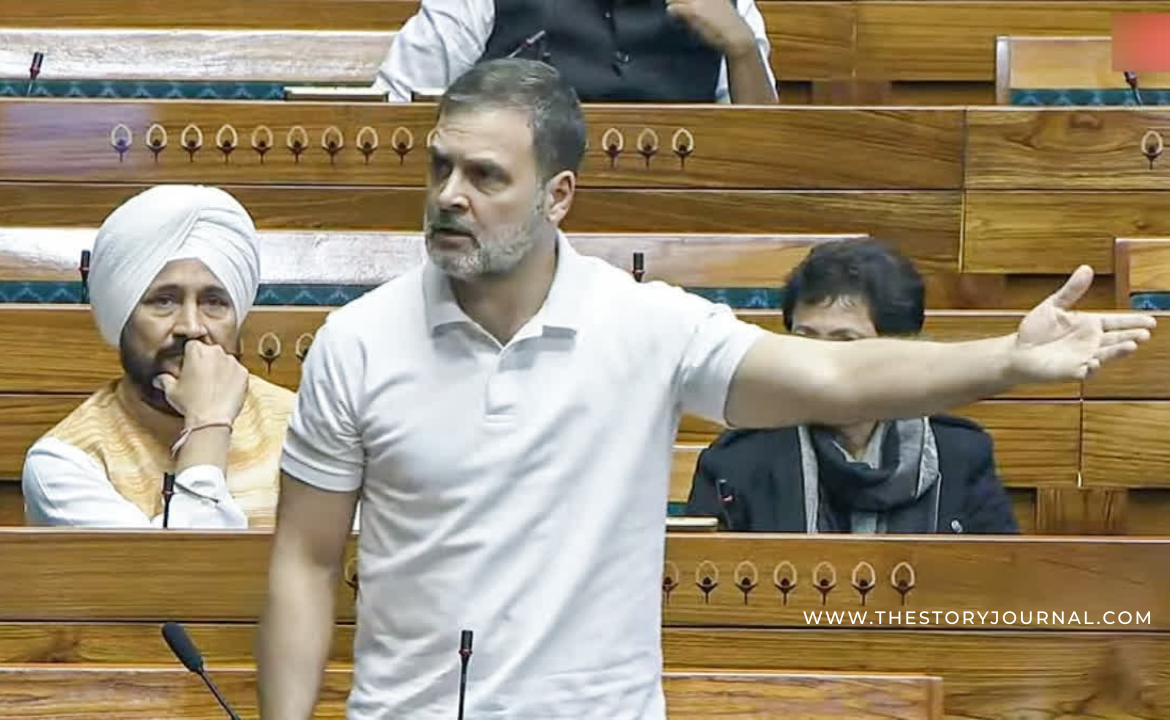
Lok Sabha Chaos as Rahul Gandhi Accuses Speaker Om Birla of Breaking Promise
Source: Twitter/X (Breaking Updates)
India’s Parliament witnessed fresh turmoil during Monday’s Budget Session as Leader of the Opposition Rahul Gandhi accused Lok Sabha Speaker Om Birla of reneging on a commitment to grant him time to speak on key national issues. According to updates circulating on Twitter/X, Gandhi had sought to raise concerns related to national security mentioned in a former Army Chief’s book and the potential impact of a proposed U.S. trade deal on Indian farmers. The disagreement triggered loud protests from opposition Members of Parliament, multiple adjournments of the House, and ultimately a day with no legislative business conducted.
The standoff quickly spilled beyond the walls of Parliament. Outside the complex, Congress leader Priyanka Gandhi described the situation as “ridiculous” and undemocratic, while Union Minister Kiren Rijiju rejected claims of any special promise to Rahul Gandhi and called for equal opportunities for all MPs to speak. Amid escalating tensions, the opposition is now reportedly considering a no-confidence motion against Speaker Om Birla.
The episode has reignited debate over parliamentary conduct, the Speaker’s role in managing proceedings, and the broader health of democratic norms during contentious sessions of Parliament.
The Context: A Charged Budget Session
Budget Sessions in Parliament are often politically charged, as they combine economic scrutiny with high-stakes political positioning. This year’s session has been particularly tense, with opposition parties seeking to press the government on national security, foreign policy, and economic implications for farmers and ordinary citizens.
Rahul Gandhi, as Leader of the Opposition, has been vocal about what he sees as shrinking space for dissent and debate in Parliament. According to the updates on Twitter/X, Gandhi had prepared to raise two sensitive issues: claims related to national security drawn from a former Army Chief’s book, and concerns over how a U.S. trade deal might affect Indian farmers. These topics touch on areas that are both politically sensitive and emotionally resonant with the public.
The expectation of being given time to speak on these matters appears to have been central to Monday’s confrontation.
The Alleged Promise and the Standoff in the House
At the heart of the controversy is Rahul Gandhi’s claim that Speaker Om Birla had promised to give him time to speak. When that opportunity did not materialize, Gandhi accused the Speaker of breaking his word. The allegation, reported on Twitter/X, immediately inflamed opposition MPs, who rose in protest inside the House.
The resulting chaos led to repeated adjournments. With slogans, counter-slogans, and disruptions dominating proceedings, the Lok Sabha was unable to conduct any legislative business for the day. Scenes of MPs standing, shouting, and demanding fairness underscored how procedural disputes can quickly derail the functioning of Parliament.
For supporters of the opposition, the incident reinforced concerns about what they perceive as selective silencing of dissenting voices. For government supporters, the disruptions were framed as unnecessary theatrics that hinder the legislative process.
Priyanka Gandhi’s Reaction Outside Parliament
Outside Parliament, Priyanka Gandhi addressed the media, calling the situation “ridiculous” and undemocratic. Her comments, shared widely on Twitter/X, added emotional weight to the opposition’s narrative. By framing the episode as undemocratic, Priyanka Gandhi positioned the standoff not merely as a procedural dispute, but as a deeper issue about the erosion of parliamentary norms.
Her remarks resonated with opposition supporters who argue that Parliament should be a forum for robust debate, particularly on matters like national security and farmers’ welfare. The choice of words also escalated the political temperature, as accusations of undemocratic conduct strike at the heart of India’s democratic self-image.
Kiren Rijiju’s Denial and the Government’s Stand
Union Minister Kiren Rijiju, responding to the controversy, denied that any special promise had been made to Rahul Gandhi. According to updates on Twitter/X, Rijiju emphasized that all Members of Parliament should be given equal opportunities to speak, rejecting the notion that one individual deserved preferential treatment.
From the government’s perspective, this stance frames the opposition’s protest as an attempt to claim special privileges rather than adhere to established parliamentary procedures. By stressing equality among MPs, the government seeks to portray itself as defending institutional norms against what it views as political grandstanding.
This divergence in narratives—opposition alleging broken promises and suppression, government asserting procedural fairness—has deepened the impasse.
The Speaker’s Role and the Question of Neutrality
The Speaker of the Lok Sabha holds a constitutionally significant position, expected to function as a neutral arbiter of parliamentary proceedings. Accusations against the Speaker, therefore, carry heavy implications. When the Leader of the Opposition claims that the Speaker reneged on a promise, it raises questions not only about procedure but also about institutional trust.
In parliamentary democracies, the credibility of the Speaker is central to the legitimacy of proceedings. Even the perception of bias can erode confidence among MPs and the public. While Kiren Rijiju’s denial suggests no such promise was made, the very public nature of the disagreement has highlighted how fragile institutional trust can become in polarized political climates.
The Opposition’s Next Move: No-Confidence Motion
According to the updates shared on Twitter/X, the opposition is now eyeing a no-confidence motion against Speaker Om Birla. While such motions are rare and often symbolic, their consideration signals the depth of the opposition’s frustration.
A no-confidence motion against the Speaker would be a dramatic escalation. It reflects not just dissatisfaction with a single day’s proceedings, but broader grievances about how Parliament is being run. Even if the motion does not succeed, the political message is clear: the opposition wants to challenge what it sees as an erosion of fairness in parliamentary conduct.
Why the Issues Rahul Gandhi Wanted to Raise Matter
The topics Rahul Gandhi sought to raise—national security references from a former Army Chief’s book and the impact of a U.S. trade deal on farmers—are politically potent. National security debates resonate deeply in India, where defense and sovereignty are closely tied to national identity. Any claims emerging from a former Army Chief’s account are likely to attract intense scrutiny and political debate.
Similarly, trade deals and their implications for farmers are politically sensitive. Farmers constitute a significant and vocal constituency, and concerns about how international agreements might affect their livelihoods have previously sparked nationwide protests. By seeking to raise these issues in Parliament, Rahul Gandhi aimed to place them at the center of public and legislative attention.
The denial of an opportunity to discuss these topics has therefore been framed by the opposition as more than a procedural slight—it is portrayed as a missed chance for democratic deliberation on matters of national importance.
The Cost of Disruption: A Day Without Business
One of the most tangible outcomes of the standoff was that no legislative business could be conducted for the day. Multiple adjournments effectively stalled parliamentary work, delaying discussions, debates, and decisions that impact governance.
For citizens watching from outside, such disruptions can be frustrating. Parliament is expected to function as a forum for debate and lawmaking, and repeated adjournments raise concerns about efficiency and accountability. While protests are a legitimate form of political expression, their frequent use risks normalizing dysfunction.
This episode highlights a recurring tension in parliamentary democracies: how to balance protest and dissent with the need for institutions to function effectively.
The Broader Pattern of Parliamentary Tensions
This standoff is not an isolated incident. In recent years, Parliament has seen repeated disruptions, walkouts, and adjournments driven by clashes between the government and opposition. Each episode adds to a growing narrative of polarization, where procedural disputes become symbolic battlegrounds for larger political conflicts.
For the opposition, disruptions are sometimes seen as the only way to draw attention to issues they believe are being sidelined. For the government, such tactics are portrayed as obstructionist and counterproductive. The result is a cycle of confrontation that undermines the image of Parliament as a space for constructive debate.
Public Perception and Democratic Health
Incidents like this shape public perception of democratic institutions. When citizens see their representatives engaged in heated confrontations that halt legislative work, it can erode trust in the political process. At the same time, visible protests can also be interpreted as signs of a vibrant democracy where dissent is alive.
The challenge lies in ensuring that dissent strengthens, rather than weakens, democratic functioning. Healthy parliamentary democracies depend on both robust debate and respect for institutional norms. The balance between the two is delicate, and episodes like Monday’s standoff test that balance.
Media, Social Media, and the Role of Twitter/X
The rapid spread of updates on Twitter/X has made such parliamentary confrontations instantly visible to the public. Clips, quotes, and reactions circulate in real time, shaping narratives before official statements or detailed explanations emerge. While this immediacy increases transparency, it can also amplify polarization, as snippets of confrontation are often shared without full context.
In this case, Twitter/X served as the primary source of breaking updates, informing the public about Rahul Gandhi’s accusations, the protests in the House, Priyanka Gandhi’s remarks, Kiren Rijiju’s denial, and the possibility of a no-confidence motion. The platform’s role in disseminating political developments underscores how digital media now mediates public understanding of parliamentary events.
What Happens Next?
As tensions simmer, several questions remain open. Will the opposition formally move a no-confidence motion against Speaker Om Birla? Will there be efforts behind the scenes to de-escalate the confrontation and restore parliamentary functioning? And will Rahul Gandhi be given an opportunity to raise the issues he wanted to discuss?
The answers to these questions will shape the tone of the remainder of the Budget Session. Continued disruptions could further delay legislative business, while any compromise or resolution might help restore a measure of normalcy.
Conclusion
The Lok Sabha standoff during Monday’s Budget Session, sparked by Rahul Gandhi’s accusation that Speaker Om Birla broke a promise to let him speak, highlights the fragile state of parliamentary functioning in a polarized political environment. With opposition protests leading to multiple adjournments, Priyanka Gandhi labeling the situation undemocratic, Kiren Rijiju denying any special promise, and talk of a no-confidence motion against the Speaker, the episode has become a flashpoint in the ongoing struggle over parliamentary norms and democratic space.
As reported through breaking updates on Twitter/X, this confrontation is about more than one speech. It reflects deeper tensions over fairness, representation, and the role of institutions in facilitating democratic debate. Whether this episode leads to meaningful reflection or simply adds another chapter to Parliament’s recent history of disruptions remains to be seen.